
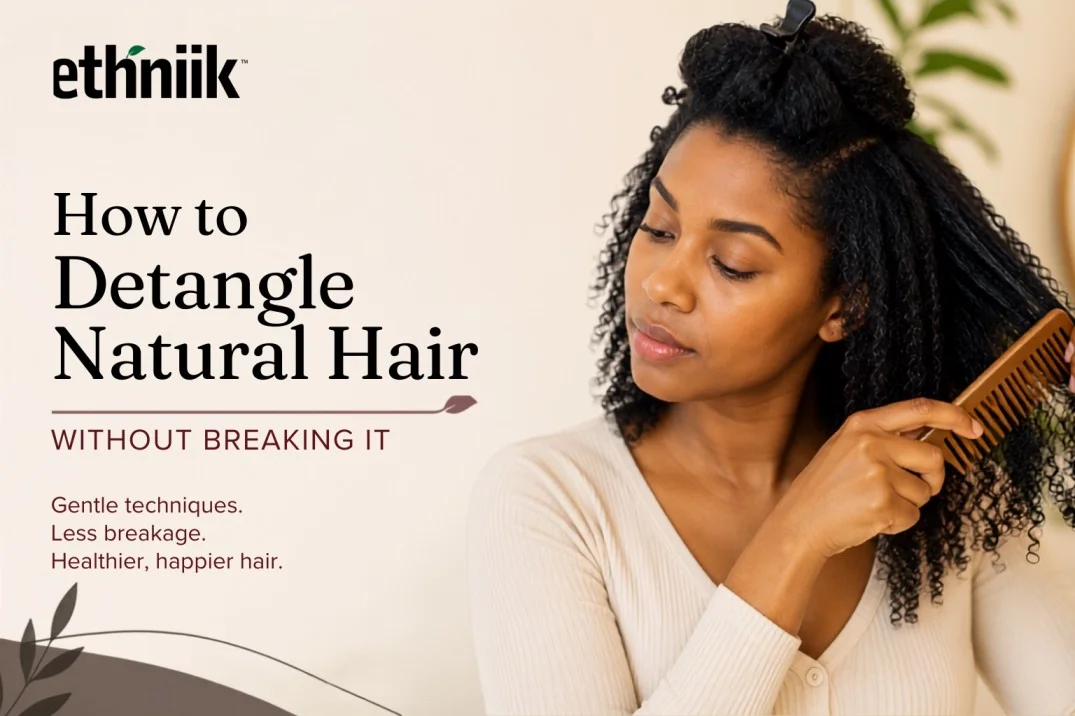
How do you detangle natural hair without breaking it?
The secret isn’t finding a stronger comb.
It’s making your hair easier to detangle before the comb even touches it.
If you’ve ever started detangling your hair and ended up with a handful of shed hair, broken strands and a headache before wash day is even over, you already know how frustrating it can be.
And here’s the thing: some shedding is completely normal. But excessive pulling, combing through dry knots, rushing through the process and repeatedly working through tangled sections can make breakage much worse.
So if your goal is to retain length and keep your natural hair healthier, let’s talk about how to detangle it properly, and what you can do to make the entire process easier.
First, Don’t Detangle Dry, Tangled Hair
This is probably the biggest mistake people make.
You look at your hair, see a few stubborn knots and think:
“Let me just get this over with.”
Then the comb goes in.
And suddenly you’re pulling, tugging and trying to force your way through every knot.
That’s exactly what you want to avoid.
Natural hair, particularly tightly curled or coily hair, can become difficult to separate when it’s dry. Instead of forcing your way through the tangles, give your hair some moisture and slip first.
This is where your pre-detangling routine matters.
A good Shampoo and Conditioner Set can give you a better starting point by helping you cleanse your hair and follow up with conditioning before you begin working through your strands.
And once your hair has some moisture and slip, you’re ready for the next step.
Work in Sections—Not All at Once
Trying to detangle your entire head at once is a recipe for frustration.
Instead, divide your hair into manageable sections.
Four sections might work for you.
Six or eight might work better if your hair is particularly thick or tangled.
There isn’t a magic number.
The point is simply to make each section small enough that you can actually work through it without rushing.
Start at the ends and gradually work your way upward.
Why?
Because if you start at the roots and drag a comb through the entire length, every knot underneath has nowhere to go.
You’re essentially pulling every tangle through every other tangle.
Starting from the ends lets you remove smaller knots first before gradually working toward the roots.
And if you come across a stubborn section, don’t fight it.
Add more moisture or conditioner, gently separate the section with your fingers and try again.
Your Fingers Should Come Before Your Comb
Before reaching for a wide-tooth comb, use your fingers.
This simple step can make a surprisingly big difference.
Finger-detangling allows you to feel where the knots are instead of blindly pulling a comb through them.
You can gently separate larger tangles, remove shed hairs that have wrapped around your strands and loosen particularly stubborn sections.
Then, once you’ve done most of the work with your fingers, you can use a wide-tooth comb to finish the section.
Think of the comb as the finishing tool, not the tool that does all the work.
And this is also where patience becomes part of your hair-care routine.
If a knot won’t move, stop.
Don’t pull harder.
Work around it.
Give Your Hair Enough Slip
Let’s talk about something that makes detangling much easier: slip.
Slip is basically how easily your fingers or a comb can move through your hair without catching on every strand.
If your hair feels rough, dry and sticky while you’re trying to detangle it, you’re going to have a much harder time.
That’s why conditioning is so important.
A conditioner can help make your hair feel smoother and more manageable, which can make the detangling process much less stressful.
For a simple routine, the Starter Pack can help you cover several of the basic steps involved in caring for your hair.
But there’s another thing to remember:
More product doesn’t automatically mean more slip.
You want enough product and moisture to make the hair manageable, not so much that you’re simply coating your hair without addressing what it needs.
What If Your Hair Is Extremely Tangled?
We’ve all had those days.
You took down a protective style.
You skipped wash day.
You had a particularly busy week.
And now your hair feels like one giant knot.
Don’t panic.
And definitely don’t attack it with a comb.
Start by separating the largest sections with your hands.
Apply moisture and conditioner.
Allow the product a little time to soften the hair.
Then work through the section gradually.
If the hair is severely tangled, you may need to spend more time finger-detangling before introducing a comb.
This is one of those situations where slowing down actually saves time.
Because rushing through a tangled section can turn a 20-minute detangling session into an hour of dealing with unnecessary breakage.
Don’t Forget the Hair Around Your Edges
Your edges deserve extra attention.
They’re often finer and more vulnerable to tension and manipulation than the rest of your hair.
So when you’re detangling around your hairline, don’t pull aggressively.
Use your fingers.
Be gentle.
And avoid repeatedly brushing or combing the same area.
If you’re specifically concerned about thinning or fragile edges, you can incorporate targeted care into your routine with products such as the Fertile Edges Set or Edge Restoring Cream.
But remember: edge care isn’t just about what you apply.
It’s also about what you stop doing.
Constant tension from tight ponytails, braids, wigs or other styles can put stress on your hairline. A product can’t completely undo the effects of repeated mechanical tension.
So protect your edges from both sides: thoughtful product use and gentler styling.
What About Hair That Keeps Breaking?
If you’re consistently finding lots of short broken pieces after detangling, it’s worth looking beyond the detangling session itself.
Ask yourself:
Is my hair usually very dry?
Am I manipulating it too often?
Do I detangle aggressively?
Are my hairstyles too tight?
Am I skipping conditioning?
Do I leave my hair tangled for long periods?
Sometimes breakage isn’t caused by one thing.
It’s the result of several small habits adding up over time.
That’s why a good hair-care routine needs to work before, during and after detangling.
For hair that’s particularly prone to breakage, the Breakage Be Gone system can be incorporated into a broader routine focused on caring for fragile strands.
The goal isn’t simply to make your next detangling session easier.
It’s to gradually make your hair healthier and easier to manage overall.
Detangling Doesn’t Have to Be a Battle
Here’s where everything we’ve talked about comes together.
You don’t need to dread wash day.
You don’t need to hear that snap every time you pull a comb through your hair.
And you don’t need a complicated 15-step routine.
Start with the basics:
Moisturise your hair.
Condition it properly.
Work in manageable sections.
Finger-detangle first.
Start at the ends.
Use a wide-tooth comb when appropriate.
Take your time with stubborn knots.
Be especially gentle around your edges.
And most importantly, don’t wait until your hair is severely tangled before you start caring for it.
Regular maintenance can make your next detangling session much easier.
What to Avoid When Detangling Natural Hair
Now that we’ve covered what to do, let’s make the opposite clear.
Don’t comb through completely dry, tangled hair
Dry knots create unnecessary resistance. Add moisture and conditioning first.
Don’t start at the roots
Work from the ends upward so you’re not dragging every knot through the length of your hair.
Don’t force a comb through a knot
If the comb stops, stop too. Use your fingers to loosen the knot before trying again.
Don’t rush
Speed isn’t the goal. Gentle, controlled detangling is.
Don’t ignore your edges
Use less tension and be more deliberate around your hairline.
Don’t keep manipulating already fragile hair
If your hair is breaking easily, give it a break from excessive styling and handling.
What Should You Use Before Detangling?
If you’re wondering what products actually make sense for a detangling routine, think in terms of function, not how many products you can use.
You need something to cleanse.
Something to condition.
Something to provide moisture and manageability.
And, depending on your hair’s needs, something to support strength and overall hair care.
For a complete starting routine, you can look at the Starter Pack.
If you’re building a routine around cleansing and conditioning specifically, the Shampoo and Conditioner Set is another straightforward option.
For hair that needs additional attention around breakage, Breakage Be Gone can fit into a targeted routine.
And for those focusing on edges and hairline care, the Fertile Edges Set provides a more targeted approach.
You can also explore Ayurgro Powder as part of a broader hair-care routine.
The important thing is not to buy everything at once.
Start with what your hair actually needs.
The Bottom Line
Detangling natural hair without breaking it comes down to one simple principle:
Make the hair easier to handle, then handle it gently.
Moisture helps.
Conditioning helps.
Working in sections helps.
Finger-detangling helps.
Starting from the ends helps.
But your technique matters just as much as the products you’re using.
So next time you’re standing in front of the mirror looking at a head full of knots, don’t reach for the comb and start fighting.
Take a breath.
Add some moisture.
Divide your hair into sections.
Use your fingers.
Start at the ends.
And take your time.
Your hair doesn’t need to be rushed into submission.
It needs to be cared for.
Frequently Asked Questions About Detangling Natural Hair
How do you detangle natural hair without breaking it?
Start with moisturised, conditioned hair and work in small sections. Use your fingers to loosen knots first, then gently work through the hair with a wide-tooth comb, starting at the ends and moving toward the roots.
Should you detangle natural hair wet or dry?
Many people find moisturised, damp or conditioned hair easier to detangle because it generally provides more slip and manageability. The best approach depends on your hair and the products you’re using, but forcing a comb through dry, stubborn tangles is usually best avoided.
Should I finger-detangle before using a comb?
Yes. Finger-detangling can help you locate and loosen knots before using a comb, reducing the amount of pulling and resistance your hair experiences.
What is the best product to use for detangling natural hair?
Look for products that provide moisture, conditioning and slip. A leave-in conditioner or well-formulated conditioner can make hair easier to separate and manage during detangling.
Why does my natural hair break when I detangle it?
Breakage during detangling can happen when hair is dry, tangled, weak or handled too aggressively. Tight hairstyles, excessive manipulation and poor detangling technique can also contribute.
How often should I detangle natural hair?
It depends on your hairstyle, hair type, routine and how quickly your hair becomes tangled. The goal is to prevent severe tangling while avoiding unnecessary manipulation.
How can I prevent my edges from breaking while detangling?
Be especially gentle around your hairline. Use your fingers, avoid aggressive brushing and reduce hairstyles that place repeated tension on your edges.
Can deep conditioning help with detangling?
Deep conditioning can help improve the softness and manageability of hair, which may make detangling easier. It works best as part of a consistent hair-care routine rather than as a one-time solution.
Does detangling help with hair growth?
Detangling doesn’t make hair grow faster. However, gentler detangling can help reduce unnecessary breakage, which may help you retain more of the hair you’re already growing.
When should I see a trichologist about hair breakage?
If you’re experiencing persistent excessive breakage, noticeable thinning, bald patches, significant edge loss or ongoing scalp problems, consider getting professional advice from a qualified hair and scalp professional rather than relying solely on hair products.
